
Sunday, May 23, 2010
Visiting my CSA farm
Yesterday I went on a tour of Dillner Family Farm, where I am getting my CSA from. It was a great experience, and definitely worth the drive through a monsoon to get there! The Dillner family farms 122 acres surrounding their house, and they do it all just with help from family. I was really impressed that just a few people could do so much work on so much land. It was also really neat to learn a little about their farming techniques, such as using high wind tunnels to extend the growing season. They also use ladybugs for pest management, and bumblebees to pollinate the crops. The Dillner family seemed like a very content, hard-working, caring, happy group. I'm glad to know my food will be coming from such a nice place!

Thursday, May 20, 2010
Making Pasta
Last night we had our first nearly-local meal of the year. I know we're supposed to be eating all the non-local food at the house, but there was a farmers market at the Strip District last weekend and I just couldn't resist! I was also excited to try the new pasta maker I got for my birthday. So using Anne Willan's Look & Cook Perfect Pasta cookbook I got from the library, Mark and I made our first fettuccine. And I found out that Mark has serious pasta making talent. We were each kneading our own piece of dough, and Mark's looked exactly like the picture and Mark had to fix mine to make it look like the picture. So thanks to Mark the pasta turned out great!
For a sauce I sauteed asparagus, mushrooms and parsley in a white-wine cream sauce. And for dessert I made a rhubarb crisp. Everything was really easy to make except the pasta, but I bet that will get easier after we do it a few times. The local ingredients were: eggs, cream, asparagus, mushrooms, and rhubarb. Now we just need to eat all the non-local food in the house in the next week and a half.
For a sauce I sauteed asparagus, mushrooms and parsley in a white-wine cream sauce. And for dessert I made a rhubarb crisp. Everything was really easy to make except the pasta, but I bet that will get easier after we do it a few times. The local ingredients were: eggs, cream, asparagus, mushrooms, and rhubarb. Now we just need to eat all the non-local food in the house in the next week and a half.
Social Inequities in Diet and Obesity
I've been reading a lot about the social inequities in diet and obesity. According to the USDA low-income families eat low-cost energy dense diets that result in a higher incidence of obesity. An article I read written by Adam Drewnowski published in Nutrition Reviews in 2009 stated:
"...more healthful foods are also more expensive and beyond the reach of many. Some low-income families limit their food budget to $100 for four people per week, or less than $4 per person per day. The only foods that can be obtained for this amount of money are high in refined grains, added sugars, and added fats, and the healthful, recommended foods are separated by an immense gap in energy costs."
I highly doubt that it is impossible for people to eat healthy food for about $4 a day, that is if people are willing to put in a little extra effort to cook. I predict that Mark and I should be able to eat local unprocessed food for a year for about $4 a person per day. Maximally we should be able to eat for less than we would receive in food stamps, which according to the USDA a family of 2 19-50 years old would receive $80.6 per week, which is almost $6 a person per day. I will keep track of the amount we spend, so that I can tally it in the end. I will also keep track of our weight, since spending less on food tends to correlate with an increase in weight.
"...more healthful foods are also more expensive and beyond the reach of many. Some low-income families limit their food budget to $100 for four people per week, or less than $4 per person per day. The only foods that can be obtained for this amount of money are high in refined grains, added sugars, and added fats, and the healthful, recommended foods are separated by an immense gap in energy costs."
I highly doubt that it is impossible for people to eat healthy food for about $4 a day, that is if people are willing to put in a little extra effort to cook. I predict that Mark and I should be able to eat local unprocessed food for a year for about $4 a person per day. Maximally we should be able to eat for less than we would receive in food stamps, which according to the USDA a family of 2 19-50 years old would receive $80.6 per week, which is almost $6 a person per day. I will keep track of the amount we spend, so that I can tally it in the end. I will also keep track of our weight, since spending less on food tends to correlate with an increase in weight.
Tuesday, May 18, 2010
Plenty (of time)
 I just finished a book called Plenty by Alisa Smith and J.B. Mackinnon. This couple writes about their experiences eating food within 100 miles of Vancouver for a year. I appreciate their stories about finding local food, however I would have liked to known more about their cooking and eating experiences. Overall it is well-written, and has some very interesting details about the loss of biodiversity that has resulted from our international food culture.
The book gave me some interesting ideas about eating locally too. The book mentions that "A study in the United Kingdom showed that the amount of time people now spend driving to the supermarket, looking for parking, and wandering the length ailes in search of frozen pizzas or pre-mixed salads is nearly equal to that spent preparing food from scratch twenty years ago". I thought this was a particularly interesting fact. I probably spend at least 2 hours a week grocery shopping. This summer all I will have to do is pick up my farm share, which will take about 20 minutes. So I will have an extra 1 hour and 40 minutes to cook and preserve food. Despite my concerns about having time to prepare and store foods, maybe I will have Plenty of time to eat locally after all.
Wednesday, May 12, 2010
The Millennium Exception
I've been getting a lot of questions about what I will include and exclude from my diet over the next year starting in June. Before I mentioned that 80% of food spending would be local. However, it doesn't seem specific enough, especially since there are plenty of non-local foods that are cheap.
So thanks to my Dad's suggestion, I am adding the "millennium exception" to my local food challenge. This means that anything that has been internationally traded for more than 1000 years will be okay to eat. 1000 years ago trading was occurring with little ecological impact, partially because it was a much smaller scale, but also because the foods were preserved and didn't have "expiration dates", so there wasn't a constant need for shipping.
What foods have been traded for more than 1000 years? So far I found out: spices, olive oil, cheese, wine, wheat, maize, rice, and dried figs. I guess I'm going to get a little history of international food trade while I'm at it!
Bottom line: I'm going to try to eat as much local as possible, but I will make exceptions for some "millennium" foods, especially spices and olive oil. Also, so as to not socially exclude myself, I will make exceptions for the occasional night out for dinner with friends.
Thursday, April 22, 2010
The Demon in the Milk
I recently found out that the raw (unpasturized) milk Mark and I have been drinking may have been contaminated with campylobacter bacteria. If we were exposed to it, it didn't have much of an affect, lucky for us. Unfortunately another family wasn't so lucky. The Pittsburgh Tribune reported on their story:
http://www.pittsburghlive.com/x/pittsburghtrib/news/pittsburgh/s_677255.html
It's very sad that that happened to Mr. Orchard, however, I really don't think they should be suing the farmer. There are known risks from drinking unpasturized milk, and there is a warning label letting the consumer know about these risks. I really hope that the state doesn't decide to make selling raw milk illegal based on this event. I believe we should still have the right to choose to buy unpasturized milk (although I probably won't be buying it again for a while). But hey, what doesn't kill you makes you stronger, right?
http://www.pittsburghlive.com/x/pittsburghtrib/news/pittsburgh/s_677255.html
It's very sad that that happened to Mr. Orchard, however, I really don't think they should be suing the farmer. There are known risks from drinking unpasturized milk, and there is a warning label letting the consumer know about these risks. I really hope that the state doesn't decide to make selling raw milk illegal based on this event. I believe we should still have the right to choose to buy unpasturized milk (although I probably won't be buying it again for a while). But hey, what doesn't kill you makes you stronger, right?
Saturday, April 17, 2010
The Future of Food
 I just watched a terrifying documentary called "The Future of Food". It discussed issues with current big business farming practices; including monocultures (which are destroying biodiversity) and genetically modified (GM) foods. GM food, primarily corn, soybeans and canola, are becoming incorporated into farmers fields, even without their knowledge or consent. And because the GM foods are patented, the companies creating them can sue (and win) against farmers for having the plants of their property, even if they did not want them there. Not only that, but no safety tests have been done on GM foods, and the United States is one of the few countries that does not require foods that contain GM foods to be labeled (because the companies that sell them pay lobbyists big bucks to prevent this). And now that corn is in pretty much everything at the supermarket (juice, yogurt, peanut butter, salad dressing, etc.) in the form of high fructose corn syrup we could be in trouble. Luckily, organic certification requires that food not contain GM products, so there's some assurance there. Now that I am throughly afraid for the future of farming, I am happy that I will soon be supporting local small farmers who grow sustainably.
Discovering Kohl Slaw
 When I first signed up for my CSA last year I thought "it's going to be tough to not decide on what I get every week like I do at the grocery store". But it turned out to be great! It was like an Iron Chef competition every week... And the secret ingredient is.... KOHLRABI!!! "What the heck is that???" I wondered as I first stared at the green ball with chutes sticking out all over it. Luckily there is a list of what is in your CSA box each week- so I was able to determine that it was a Kohlrabi. I found a great recipe for Kohlrabi Cole-Slaw (aka Kohl Slaw) online. Had I not had a farm share I could have gone my whole life without getting to know about the Kohlrabi.
 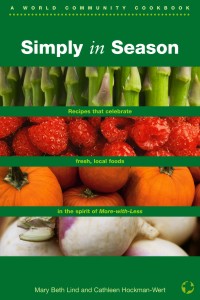 It can be quite difficult to transition from shopping for ingredients that suite your recipes to shopping for recipes that suite your ingredients. There are some great cookbooks that help you with the switch to eating seasonal. One of my favorites is Simply in Season. It sorts the recipes by season, and by key ingredients. So if you have a pile of green onions and radishes, the book has some great ideas for what to do with them.
 The CSA selection
I investigated my options and I decided to get my CSA from Dillner Family Farm. There were tons of great options in the Pittsburgh area, and my main criteria were location of the drop-off point, cost, and whether the farm minimizes the use of pesticides and fertilizer. With the last criteria it was tough to decide between organic and non-organic farms but I read quite a bit about how the "organic" certification can be difficult for small farmers to get because there is a lot of cost and paperwork associated with the certification itself. I like that although Dillner Family Farm is not certified organic they use sustainable farming methods.
Here's the farm website:
Dillner Family Farm http://www.dillnerfamilyfarm.com
what's a CSA??
So what is a CSA? According to the USDA website (http://www.nal.usda.gov/afsic/pubs/csa/csa.shtml):
There are plenty of resources for finding a CSA or other local food near you. A great website for nationwide local farm resources is:
Local Harvest
http://www.localharvest.org/
For Pittsburgh locals:
Grow Pittsburgh
http://www.growpittsburgh.org/
Community Supported Agriculture consists of a community of individuals who pledge support to a farm operation so that the farmland becomes, either legally or spiritually, the community's farm, with the growers and consumers providing mutual support and sharing the risks and benefits of food production. Typically, members or "share-holders" of the farm or garden pledge in advance to cover the anticipated costs of the farm operation and farmer's salary. In return, they receive shares in the farm's bounty throughout the growing season, as well as satisfaction gained from reconnecting to the land and participating directly in food production. Members also share in the risks of farming, including poor harvests due to unfavorable weather or pests. By direct sales to community members, who have provided the farmer with working capital in advance, growers receive better prices for their crops, gain some financial security, and are relieved of much of the burden of marketing.
There are plenty of resources for finding a CSA or other local food near you. A great website for nationwide local farm resources is:
Local Harvest
http://www.localharvest.org/
For Pittsburgh locals:
Grow Pittsburgh
http://www.growpittsburgh.org/
Subscribe to:
Posts (Atom)